

Last Updated: November 1, 2026
Quick Summary
Wooden educational toys are often open-ended, durable and invite a child to do something rather than watch something, but they are not automatically better just because they are wood. The material matters less than how the toy is designed, finished and matched to your child's stage.
- A poorly finished wooden toy with sharp edges or loose small parts is worse than a safe plastic one.
- Wood has weight, grain and temperature, giving more sensory feedback than hollow plastic.
- Plastic wins for bath toys, outdoor water play and anything that must be lightweight.
- For children under three, avoid anything that fits inside a toilet paper tube.
- If you buy one wooden toy, make it wooden building blocks for kids.
Table of Contents
- Why Wooden Educational Toys Earn Their Place in the Toy Box
- Wooden Toys for Toddlers: Matching the Toy to the Milestone
- Montessori Wooden Toys and Open-Ended Play
- Safe Non-Toxic Wooden Toys: What to Check Before You Buy
- Wooden Building Blocks for Kids: The Longest-Lasting Toy You Can Buy
- Choosing Your First Wooden Toy Set at Mouton Royal
- Frequently Asked Questions
Why Wooden Educational Toys Earn Their Place in the Toy Box
Many parents notice that some toys hold a child's interest far longer than others, and simple wooden toys are often among the longest-lasting favourites.
Many parents find that simple toys get the most use. Wooden educational toys are often open-ended, durable, and invite a child to do something rather than watch something.
Here is the honest version, though. Wooden toys are not automatically better just because they are wood. A poorly finished wooden toy with sharp edges or loose small parts is worse than a safe plastic one. The material matters less than how the toy is designed, finished, and matched to your child's stage.
How Wooden Toys Compare to Plastic for Learning
The real difference comes down to feedback and distraction. A plastic toy with flashing lights and pre-recorded sounds does the playing for the child.
Open-ended play is the term for play with no fixed outcome, and wooden toys are built for it.
There is a tactile argument too. Wood has weight, grain, and temperature.
Durability is the practical winner. A solid hardwood toy handed down from an older sibling often still works well.
Where plastic wins: bath toys, outdoor water play, and anything that needs to be genuinely lightweight for a small child to carry.
Wooden Toys for Toddlers: Matching the Toy to the Milestone
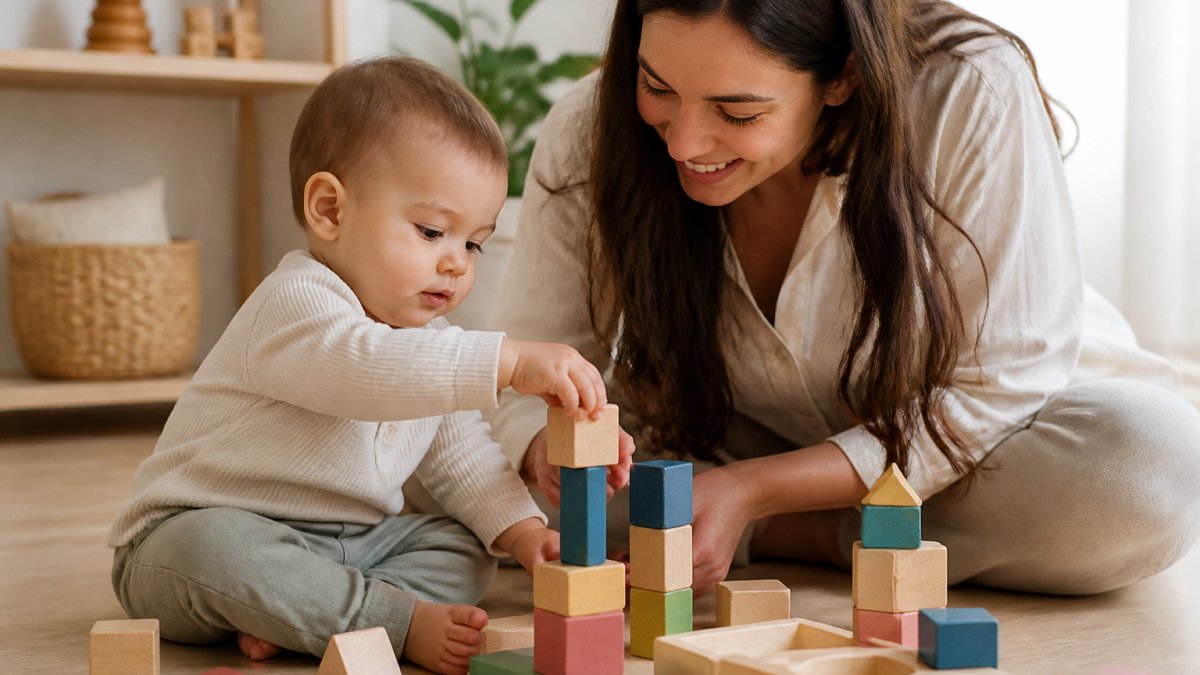
The single biggest mistake we see parents make is buying for the child's age on the box rather than the child's actual stage. A toy that is too advanced frustrates a toddler and gets tossed aside. One that is too simple gets ignored. Match the toy to what your child can almost do, not what they have already mastered.
12 to 18 Months: Cause, Effect, and First Stacking
At this stage, children are learning that their actions change the world. They drop things to hear the sound. They push a button to see what happens. The right wooden toys for toddlers at this age are simple cause-and-effect toys with big, easy-to-grab pieces.
What works well:
- Chunky wooden stacking rings with a wide base
- A wooden shape sorter with two or three simple shapes
- Large wooden blocks sized so a small hand can hold one comfortably
- A wooden push-along toy for early walking
Skip anything with small parts at this age. Mouthing is constant, and small pieces are a choking risk. Look for smooth, rounded edges and a finish you would feel comfortable with your child putting in their mouth.
2 to 3 Years: Puzzles, Sorting, and Pretend Play
By two and three, children start to sort, match, and imagine. This is when wooden puzzles, shape sorters, and simple pretend-play sets earn their keep. A wooden puzzle with knobs is easier for small fingers than a flat jigsaw, and it teaches shape recognition and problem-solving at the same time.
Pretend play takes off here. A wooden play kitchen, a set of wooden food, or a simple wooden doll encourage imagination and independent play. These toys let a child act out what they see adults doing, which is how language and social skills develop.
A common mistake is buying a big pretend-play set too early. A two-year-old mostly wants to carry, stack, and dump. A three-year-old wants a story. If your child is closer to two, start with a small set and add to it.
Montessori Wooden Toys and Open-Ended Play
Montessori wooden toys follow the same principle: fewer features, more possibility. The Montessori approach favors natural materials, simple design, and toys that let a child work independently at their own pace.
Open-ended play is the engine behind this. A toy with one correct answer teaches one thing. A toy with no correct answer teaches a child to think.
What most guides miss is that open-ended play is not just about the toy. It is about how much the adult steps back. A wooden toy on the floor with a parent watching quietly gets more use than the same toy with a parent directing every move.
For screen-free play, this matters even more.
Safe Non-Toxic Wooden Toys: What to Check Before You Buy
Safe non-toxic wooden toys start with the finish and the construction, not the label on the box. This is the part most parents skip, and it is the part that matters most for a child who mouths everything.
What to check before you buy:
- Finish: Look for water-based, non-toxic paints and finishes. Ask the retailer for the finish specification if it is not listed.
- Wood type: Hardwood like maple or beech holds up better than softwood, which dents and splinters.
- Edges: Smooth, rounded, sanded edges. Run your finger along every edge before handing a toy to a child.
- Small parts: For children under three, avoid anything that fits inside a toilet paper tube (Toy safety tips). That is the standard choking-hazard test.
- Construction: Check that joints and screws are tight and that nothing can be pulled off.
Small Parts, Finishes, and Canadian Safety Rules
Toys sold in Canada are subject to federal safety requirements administered by Health Canada, which address matters such as small parts and sharp edges (Industry Guide to Health Canada's Safety Requirements for Children's Toys and Related...). You can check the current requirements through Health Canada's toy safety guidance.
Our advice: do not take "non-toxic" on a product page at face value. Ask for the finish specification or testing documentation. A reputable retailer should be able to point you to what a toy is finished with. If a seller cannot tell you what a toy is painted with, that is your answer.
Wooden Building Blocks for Kids: The Longest-Lasting Toy You Can Buy
If you buy one wooden toy, make it wooden building blocks for kids. No other toy spans as many ages or gets as much use. A one-year-old stacks two blocks. A three-year-old builds a tower. A five-year-old builds a city.
Building and stacking toys develop fine motor skills, hand-eye coordination, and early problem-solving as children figure out balance and structure. Counting toys and sorting games can be built right into block play.
The durability argument is strongest here. A good hardwood block set lasts through multiple children and still looks fine. That is why blocks are the toy most often handed down, and why they are worth buying well once.
Quick Comparison: Toy Types, Skills, and Age Fit
| Toy Type | Main Skills | Best Age | Longevity |
|---|---|---|---|
| Stacking rings | Fine motor, cause and effect | 12-18 months | Moderate |
| Shape sorters | Matching, problem-solving | 18 months-3 years | Moderate |
| Wooden puzzles | Shape recognition, focus | 2-4 years | High |
| Building blocks | Coordination, creativity, counting | 1-6+ years | Very high |
| Pretend-play sets | Imagination, language, social skills | 2-5 years | High |
| Musical toys | Rhythm, sensory play | 6 months-3 years | Moderate |
Choosing Your First Wooden Toy Set at Mouton Royal
The challenge is not finding wooden toys. It is finding ones you can trust, matched to your child's stage, without wading through a hundred listings that all claim to be "non-toxic" and "educational." That is the gap we built Mouton Royal to close.
Mouton Royal offers a curated selection of kids' lifestyle products for modern families, with a focus on natural materials. Orders over $75 ship free across Canada. For current product options and prices, please visit the Mouton Royal website.
Start with one good set of blocks or a wooden puzzle matched to your child's age. Add a pretend-play piece as they grow. Visit Mouton Royal to explore our current selection and build a toy box your kids will enjoy.
Frequently Asked Questions
Are wooden toys better for learning than plastic toys?
Wooden toys tend to offer simpler, open-ended designs that invite problem-solving and imagination rather than flashing lights and preset sounds. That simplicity supports focused, independent play. Wooden educational toys also last longer and can be passed down. Plastic toys aren't inherently bad, but many are designed around a single scripted use. The best choice is a mix that includes open-ended wooden pieces your child can stack, sort, and build with in different ways.
What should I look for in safe non-toxic wooden toys?
Check for smooth, splinter-free surfaces and water-based, non-toxic finishes rather than unknown paints. Look for solid hardwood such as maple or beech, and confirm the toy meets Canadian safety requirements for the child's age. Avoid small detachable parts for children under three, and inspect seams and joints for tight construction. Reputable retailers should be able to explain their sourcing and finish standards. When in doubt, ask for documentation before you buy.
Which wooden toys are best for toddlers?
For toddlers, stacking rings, chunky wooden puzzles, shape sorters, and large building blocks work well because they match developing fine motor skills. Around two to three years, pretend-play sets and simple sorting and counting toys add new challenges. Choose pieces large enough to be safe for the age, with rounded edges and a smooth finish. A small rotation of three or four toys keeps play focused and avoids overwhelm.
Are Montessori wooden toys worth buying?
Montessori wooden toys focus on real materials, simple forms, and open-ended use, which aligns with how young children learn through hands-on exploration. They often cost more than mass-market toys, but their durability and versatility can make them good value over time. You don't need a full Montessori setup. A few well-chosen pieces, such as a stacking toy, a shape sorter, and a set of blocks, cover most developmental bases.

0 comments